Luc–Eliza kinship and control relationship
The Reincarnated Demon King's Host Just Wants to Live in Peace, But the Hero Won't Leave Him AloneLuc–Eliza kinship and control relationship binds blood relation to the institutional demands placed on the Hero. Eliza presents herself as Luc’s rightful guardian because he is her blood, yet her version of kinship requires obedience, sacrifice, continued training, and the preservation of a heroic lineage. Luc’s resistance therefore becomes more than a family quarrel: it is a struggle over whether kinship will mean protection or possession, and whether a Hero may choose a future outside the destiny assigned to him.
Blood Relation and the Language of Duty
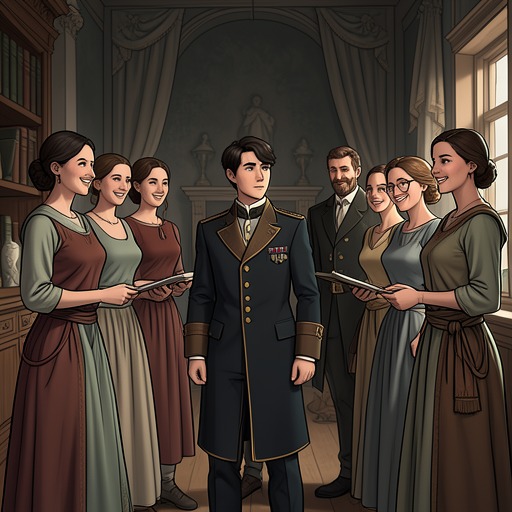
Eliza and Luc share dark hair and a tanned complexion, but their physical resemblance does not produce emotional intimacy. Eliza appears as an older Hero in a navy, gold-edged coat, with a combat-forged body and an expressionless face. Her amber eyes contain no warmth, and her presence frightens Theo because he suspects that she can perceive Malthios beneath his human appearance. When Eliza claims that Luc is her blood and that it is therefore natural for her to watch over him, she frames surveillance as familial care.
That claim is immediately challenged by Theo, who sees the damage Eliza has inflicted on Luc rather than the legitimacy of her concern. Theo accuses her of turning a child into a weapon and rejects her appeal to duty as a justification for cruelty. Eliza answers by calling Theo a coward who abandoned his own duty. The exchange exposes the central asymmetry in their relationship: Eliza treats duty as an obligation that overrides personal freedom, while Luc and Theo understand a meaningful life as one in which responsibility must still leave room for consent.
Training, Punishment, and Reproductive Expectation
Luc’s memories give Eliza’s authority a concrete history of violence. When he was approximately twelve, she caught him neglecting his training, defeated him in a duel, and took the Hero’s sword from him. She then instructed the healers to allow his injuries to heal without intervention, explicitly treating pain as a reminder of his duty. The punishment reveals how completely Eliza subordinates Luc’s bodily welfare to the production of a disciplined Hero: even healing becomes conditional upon obedience.
Eliza’s control also extends into Luc’s intimate life. Luc recounts that a former lover, Julius, wanted to join his party, but Eliza ordered Julius to refuse and threatened to take everything from him if he did not leave Luc alone. Julius believes that Eliza wanted Luc to continue their bloodline and sire the next Hero, a future she considered more important than Luc’s attachments. In this structure, Luc’s relationships are not private choices. They are assessed according to whether they support heroic succession, and partners who might distract him or prevent the expected continuation of the line become obstacles to be removed.
Luc’s history of short relationships reinforces the cost of this system. His first serious connections were with a maid in training and a squire from the capital, where he grew up; the squire ended their relationship after Luc’s departure was announced, despite Luc asking him to come along. Later relationships formed during extended stays in towns but could not last. Luc describes this instability as the fate of the Hero, presenting personal loss as an ordinary consequence of a life organized around compulsory service.
Open Confrontation and Luc’s Refusal
The relationship reaches its clearest crisis when Luc refuses to let Eliza continue directing his life. In front of the others, he says that he appreciates what she has done for him but declares that their arrangement will end after the demons are defeated. His statement that his life is not hers to control directly contests the premise that blood gives Eliza ownership over his future.
Eliza responds by opposing his heart to his destiny and accusing him of throwing away both his duty and his great inheritance for a whim. Luc answers that he has a heart and turns her argument back against her with a deliberately cruel remark about her inability to secure a partner for herself. The exchange is not a calm reconciliation attempt; it is a rupture in which Luc uses anger to make visible the resentment that Eliza’s discipline has kept beneath the role of the obedient Hero. Her expression remains controlled, but her eyes show rage, and she fixes Theo with an unmistakable promise of pain as Luc leads him and the party away.
The conflict is also intimate because Eliza treats Theo as a threat to the future she has planned for Luc. Theo’s relationship with Luc represents a life centered on love, shared residence, and mutual choice rather than bloodline continuation. Eliza’s opposition thus makes Luc’s partnership politically significant: choosing Theo means refusing the reproductive and dynastic purpose Eliza has assigned to him.
Chosen Life Against Inherited Destiny
At the later judgment, Eliza states the stakes without disguise. She asks whether Luc is truly willing to end their bloodline and discard everything for which he has trained his whole life. Luc replies that this is the only choice he has ever made for himself: he has chosen a quiet, peaceful life with the man he loves, and he wants a world in which people born with the Hero’s gift can choose their fate rather than remain bound to duty.
Luc’s answer transforms the relationship from a private struggle into a challenge to the Heroic duty system. Eliza represents a model in which blood, training, and inherited power determine the shape of a life. Luc does not deny that he has obligations, but he refuses to accept that obligation requires the surrender of every other form of belonging. His chosen household with Theo, like the care Theo receives from Imani and Dale, demonstrates that family can be made through sustained protection, labor, and presence rather than secured through blood or reproduction alone.
Luc’s declaration that Theo is Malthios’s prison and that he is Theo’s humble guard further recasts loyalty. Eliza’s guardianship seeks to contain Luc within a lineage; Luc’s guardianship protects Theo while affirming Theo’s agency and their shared future. The contrast is deliberate: one relationship uses the language of care to enforce control, while the other treats protection as a commitment freely accepted.
Consequences and Narrative Significance
Eliza and Luc do not reach reconciliation. Their relationship remains marked by a final separation between the destiny Eliza defends and the life Luc chooses. Luc’s decision ends his compliance with her control and rejects the expectation that he must produce the next Hero. It also permits him to remain with Theo after the larger conflict, making domestic peace rather than hereditary service the horizon of his story.
The relationship’s significance lies in its contrast between biological kinship and chosen kinship. Eliza invokes blood to claim authority, while Leafel receives Theo through everyday acts of care: Imani tends him when illness leaves him helpless, Dale feeds him and describes the instinctive bond that drew them to him, and the village welcomes him home as family. When Theo returns, Imani and Dale embrace him and Dale calls him their son. Against that communal recognition, Eliza’s blood claim appears insufficient because it offers surveillance and command without the warmth that makes kinship livable.
The epilogue confirms the alternative future Luc defended. In autumn, he lives with Theo at the shop, helps with gardening despite lacking patience for it, and is distracted from discipline by affection rather than summoned back to training. Theo continues the practical work of harvesting and storing ingredients for winter, while Luc remains beside him in an ordinary shared life. The image answers Eliza’s demand for heroic continuity with a different form of continuity: not a new bloodline, but enduring partnership, work, care, and the freedom to remain together.